



Wholesale
Perfume Retail Margin for Wholesale Buyers
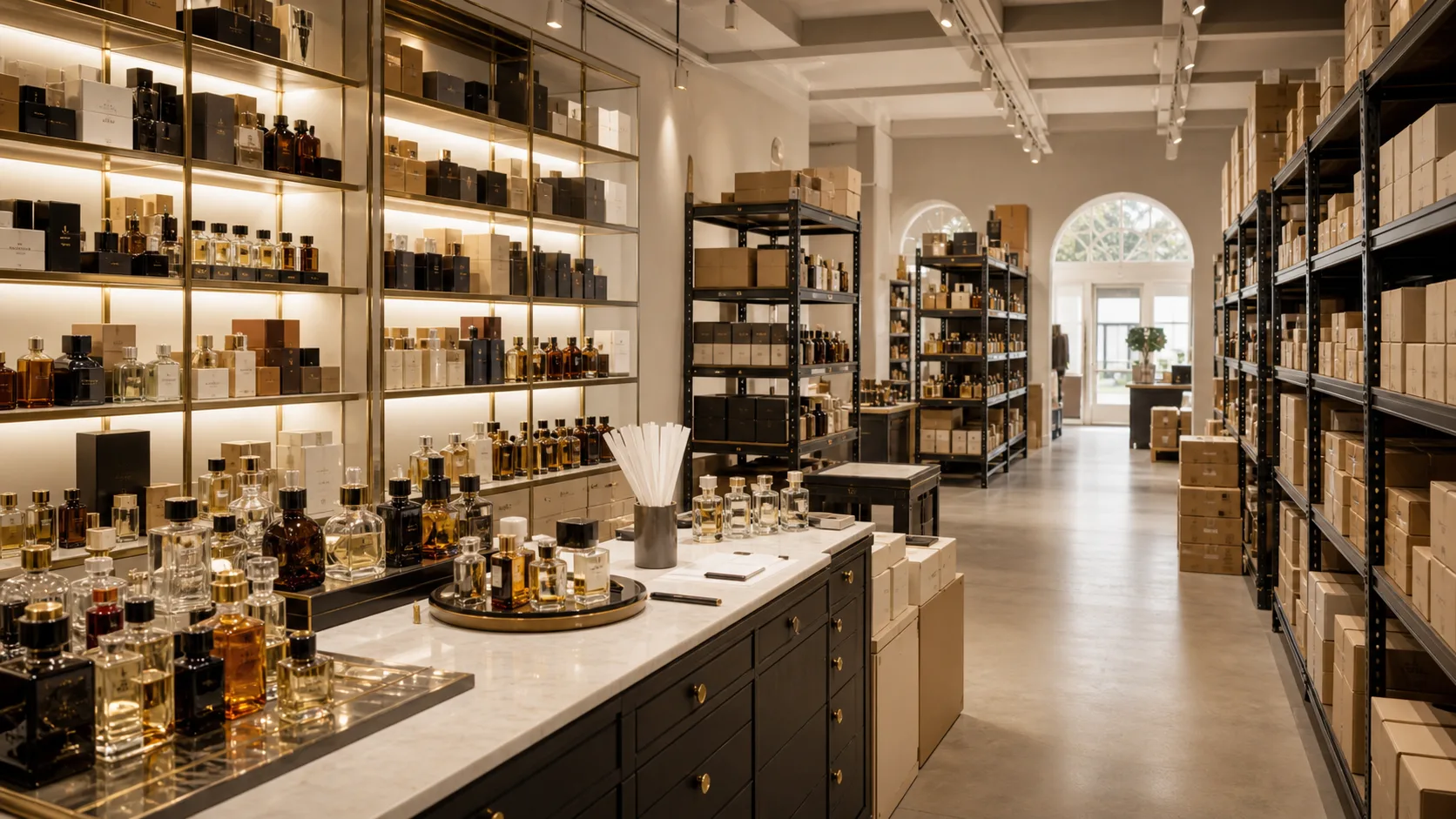
Perfume retail margin is the money left after wholesale cost, freight, duty, payment fees and selling costs. A 300-unit mixed order lets you test 12-20 fragrances before you commit more cash to the winners.
Last updated: 16 September 2026
Perfume retail margin is the share of your selling price left after product cost, freight, duty, payment fees and selling expenses. A 300-unit mixed order from USD 1.22 per 30ml bottle lets you test demand before scaling your winners.
The supplier price is only the first line in your calculation. Your real decision number is landed cost: the amount paid to place one saleable bottle on your shelf. If you price from the supplier invoice alone, freight, clearance and selling costs will reduce the cash left for your next order.
This guide gives you a repeatable method. Use it before your first order, when setting retail prices and when deciding which fragrances deserve a larger reorder.
Perfume Profit Starts With Landed Cost, Not Supplier Price
Start with five numbers for each SKU:
Product cost per bottle.
Freight and handling per bottle.
Duty, tax and clearance per bottle.
Payment and marketplace fees per sale.
Selling costs such as packaging, delivery support, commissions and promotions.
Add the first three numbers to calculate landed cost. Add payment and selling costs when you calculate contribution profit. Keep both figures visible. Landed cost tells you what the bottle costs to place in stock. Contribution profit tells you what remains after a customer buys it.
Ballerina Perfume supplies 30ml fragrances from USD 1.22 and 100ml fragrances from USD 5.72, ex-works Dubai. Ex-works means freight, insurance, destination charges, duties and local delivery are not included. Ask your freight agent and clearing agent for written figures before you approve a retail price.
Cost line | 30ml starting point | 100ml starting point | Source |
|---|---|---|---|
Product cost | USD 1.22 | USD 5.72 | Ballerina ex-works price |
Freight per bottle | Your confirmed quote | Your confirmed quote | Your freight agent |
Duty and clearance per bottle | Your confirmed quote | Your confirmed quote | Your clearing agent |
Local delivery per bottle | Your confirmed quote | Your confirmed quote | Your local carrier |
Landed cost | Total of the four lines | Total of the four lines | Your calculation |
Do not copy freight or duty figures from another importer. Carton count, route, shipping method and local rules change the result. Use the quotation attached to your own order.
Margin and Markup Are Different Numbers
Markup measures profit against cost. Margin measures profit against selling price. A product bought for 10 and sold for 20 has a 100% markup, but a 50% gross margin.
Gross profit = selling price − landed cost
Gross margin % = gross profit ÷ selling price × 100
Markup % = gross profit ÷ landed cost × 100
Selling price for a target margin = landed cost ÷ (1 − target margin)
The last formula is the safest pricing shortcut. Once you know landed cost, select your target margin and calculate the minimum selling price.
Target gross margin | Divide landed cost by | Selling-price multiplier |
|---|---|---|
40% | 0.60 | 1.67× |
50% | 0.50 | 2.00× |
60% | 0.40 | 2.50× |
70% | 0.30 | 3.33× |
These are mathematical checkpoints, not promised earnings. Your final result must include the costs charged in your market.
Calculate Contribution Profit Before You Discount
Gross margin is not the cash you keep. A card fee, marketplace commission, local delivery subsidy or salesperson commission is charged after the product reaches your shelf. Subtract those selling costs from gross profit to find contribution profit.
Contribution profit = selling price − landed cost − payment fees − sales commission − promotion cost − delivery support
If you offer a discount, recalculate contribution profit using the discounted selling price. Never approve a promotion only because gross margin still looks positive. The promotion must leave enough cash for rent, salaries, damaged stock and the next purchase order.
Planning your first assortment? Review our manufacturer-direct wholesale perfume terms. You can mix 300 units across brands and sizes instead of placing 300 units on one fragrance.
Use a 300-Unit Order to Test Demand
A first order should answer one question: which fragrances will your customers reorder?
The Ballerina wholesale MOQ is 300 units, mixed freely across brands and sizes. A practical test can cover 12 to 20 fragrances rather than placing all your cash into one scent. Give each SKU enough units to produce a real sales signal, but keep enough variety to test fresh, sweet, woody, floral and aromatic preferences.
Start with three groups:
Proven demand: allocate the largest share to products with existing sales evidence. Use the best-selling fragrance collection as one input, then compare it with demand in your own store.
Accessible trial sizes: use a pocket perfume assortment to give price-sensitive buyers an easier first purchase.
Controlled experiments: reserve a smaller share for new scent profiles, packaging or price points.
Do not judge a SKU only by units sold. Record days in stock, discount level and contribution profit. A fragrance that sells 20 units at full price can produce more cash than one that sells 30 units after repeated discounts.
Track Margin by SKU and by Order
One average margin can hide weak products. Track each SKU separately, then review the whole shipment.
Your weekly sheet should include opening stock, units sold at full price, units sold at a discount, average selling price, landed cost per unit, contribution profit per unit, closing stock and days since the last sale.
Review the sheet every 7 days during a test order. After 30 days, place each SKU into one of three actions:
Reorder: steady sales, acceptable contribution profit and limited discounting.
Hold: early interest, but not enough completed sales for a larger commitment.
Exit: slow movement or contribution profit below your operating target.
This prevents a popular product from consuming cash without returning enough profit. It also stops slow stock from remaining invisible inside a blended margin figure.
Protect Cash Flow When You Reorder
Margin and cash flow must be reviewed together. A strong margin does not help if the product takes 12 months to sell. A smaller margin can be useful when stock turns quickly and customers reorder without heavy advertising.
Before increasing an order, check how many units sold in the last 30 days, how many sold at full price, how much cash remains after selling costs, how many days of stock remain and whether you can pay the next 50% deposit without delaying another operating expense.
Ballerina’s payment term is 50% deposit and 50% before dispatch. Stocked SKUs are prepared in 3–5 working days. Made-to-order production takes 3–4 weeks. Build those dates into your reorder point so you do not replace profitable sales with an avoidable stockout.
Buyers serving Dubai, Deira and the wider UAE can also review the UAE wholesale perfume supply page for local ordering and delivery context.
Why Manufacturer-Direct Supply Changes the Calculation
Ballerina Perfume is a manufacturer, not a general trading supplier. Our fragrance brands are developed and macerated in-house in Dubai. Manufacturer-direct supply gives you one source for product data, batch preparation, export documents and repeat orders.
It does not remove freight, duty or retail expenses. It gives you a clear starting price and a repeatable supply process. Your responsibility is to confirm destination costs, set the selling price and track the result by SKU.
For every export order, we provide a commercial invoice, packing list, certificate of origin and batch composition notes. Use those documents when requesting a freight or clearance quotation. Your local agent remains responsible for confirming destination permits, duties and clearance charges.
A Simple Decision Rule
Do not ask whether a bottle has a “good margin.” Ask whether the selling price covers landed cost, selling cost, operating expenses and the cash required for the next order.
Calculate the full cost before ordering. Test demand across a mixed 300-unit assortment. Track results every 7 days. Reorder the SKUs that sell with limited discounting and leave enough contribution profit to finance the next cycle.
That process turns perfume margin from a guess into an operating number.
Frequently Asked Questions
What is a good profit margin for perfume retail?
There is no universal percentage because freight, duty, selling fees and retail prices are different in each market. Calculate your landed cost first, then test 40%, 50%, 60% and 70% gross-margin price points using the table above.
How do I calculate perfume retail profit?
Subtract landed cost from selling price to calculate gross profit. Then subtract payment fees, commissions, promotions and delivery support to calculate contribution profit; review the result every 7 days by SKU.
Can I test perfume margins with a small wholesale order?
Yes. Ballerina Perfume accepts a 300-unit mixed wholesale order across brands and sizes, with 30ml fragrances starting from USD 1.22 ex-works Dubai. Use the first order to test 12–20 fragrances before increasing stock on the winners.